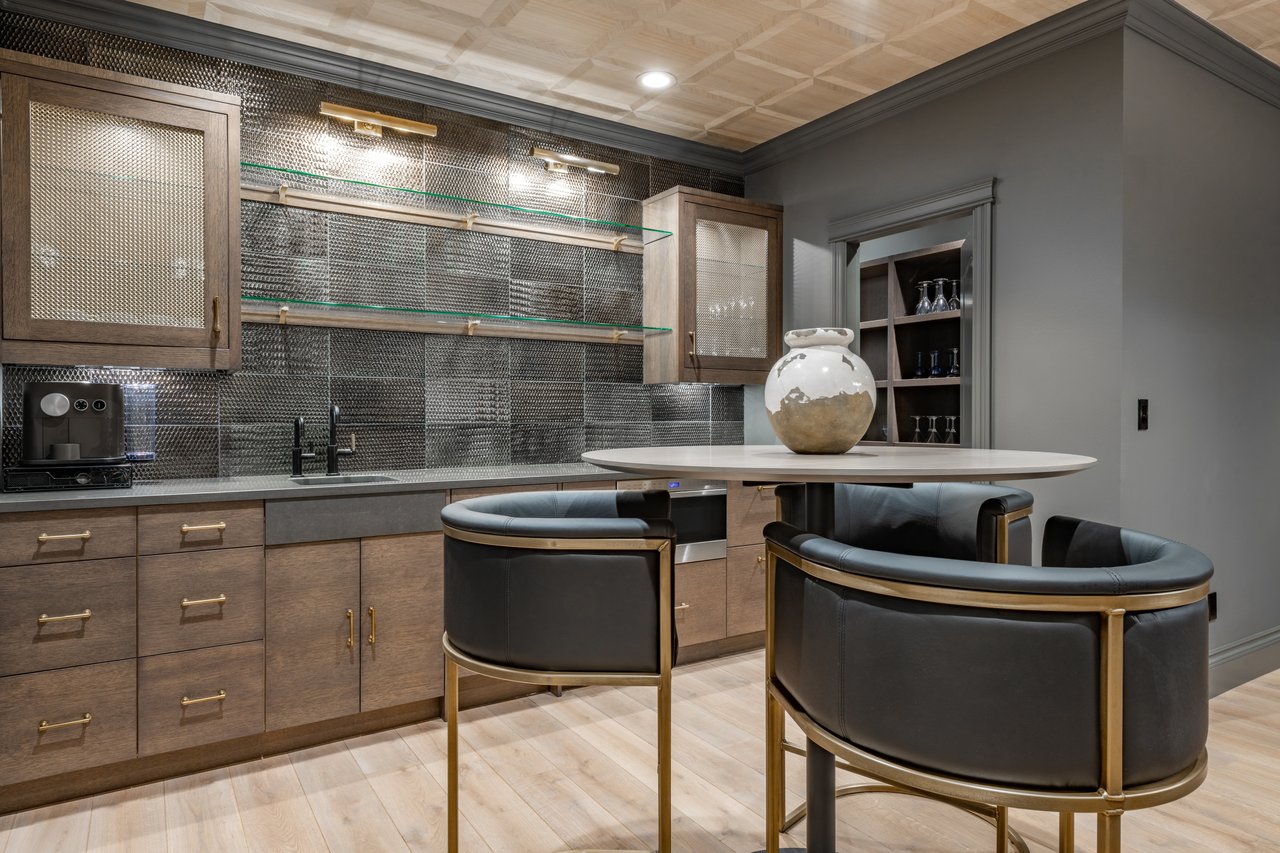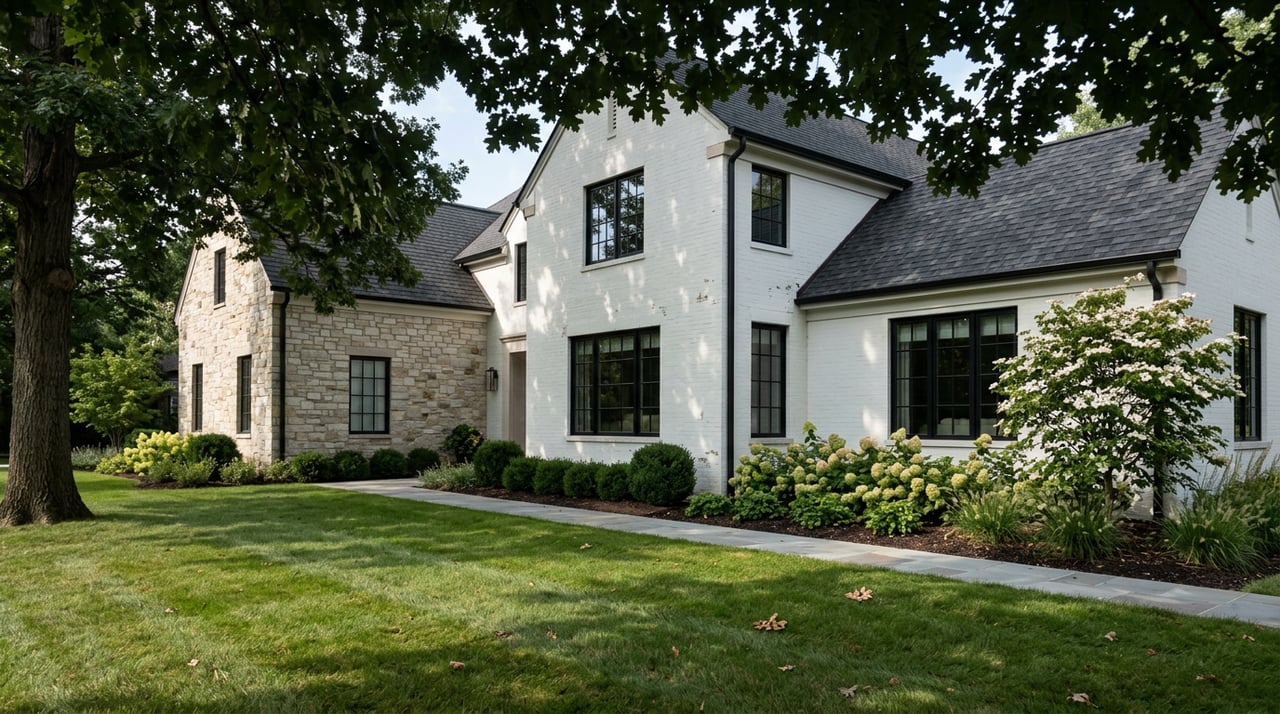
Two Ladue listings sit at nearly identical asking prices this summer. One is a mid-century ranch on 1.2 acres near St. Louis Country Club, presented in "as-is" condition with a kitchen that has not been updated since the Carter administration. The other is a renovated four-bedroom on a smaller lot with new mechanicals and a designer-led kitchen. Same price. Same municipality. Same zip code on the search filters.
A buyer using a portal median to calibrate expectations will treat these as comparable inventory. They are not comparable at all. They are different products, priced by different logic, and mistaking one for the other is the single most common way move-up buyers lose money in this market.
The Ladue median is not a price for a house. It is a price for a lot with something on it. Once you see that, every listing in the city reads differently.
The number that hides the mechanism
The commodity data is easy to find. Ladue's median list price sat at roughly $1.69 million in July 2026, at about $400 per square foot, with a median of 29 days on market. Zillow's home value index pegged the typical Ladue home at $1,132,246, up 3.2% year over year as of mid-2026. Redfin's per-square-foot sale figure ran closer to $357.
Three sources, three different numbers, all technically correct. The gap between them is the story.
That spread exists because Ladue's housing stock is bimodal. On one end you have original mid-century homes, many under 3,000 finished square feet, some deferred on maintenance, sitting on lots that are the entire reason anyone is looking in the first place. On the other end you have new-construction and heavily renovated homes on similar lots, finished to a specification that makes the improvement itself worth seven figures. A median blends both. Neither buyer is actually shopping the median.
Why the lot has its own floor
Here is the mechanism most buyers coming from other metros miss. Ladue is only about 8.5 square miles. Residential District A is drafted for large-lot single-family use, and the historical three-acre minimum in the most restrictive portion of the code was upheld by the Missouri Supreme Court in Flora Realty and Investment Co. v. City of Ladue in 1952, a precedent that still shapes how the current zoning ordinance treats density. New lots are not being created. Existing lots trade.
That fixed supply meets an active teardown-and-rebuild demand. Local custom builders such as Hibbs Luxury Homes, Kingbridge Homes, Slavin Homes, and WS Custom Homes routinely acquire smaller, older homes specifically because the lot is the asset. Hibbs has published that tear-down-candidate homes in Ladue tend to floor around $550,000, against a broader median that ran near $1.4 million in 2024 and has climbed since. Construction cost benchmarks for the city sit at roughly $165 to $295 per square foot, with luxury custom builds at the top of that range, per Buildora IQ's Ladue estimator. A 2,400-square-foot rebuild pencils out at $395,000 to $710,000 in hard costs before soft costs, contingency, and the land itself.
Do the math from a builder's chair. If a finished new-construction home on a Ladue lot needs to sell for $2.4 million to justify the project, and construction plus soft costs consume $900,000 to $1.2 million, the lot has to be acquired for something like $1.1 to $1.4 million. That builder math is what puts a floor under every livable lot in the city, regardless of what the house on it looks like.
A reading guide by price band
The practical way to compare Ladue listings is to estimate how much of the asking price is land and how much is improvement. Rough bands for 2026:
| Ask price | Typical product | Land share of price | What the improvement usually is |
|---|---|---|---|
| $700K to $1.1M | Original mid-century on a smaller lot, often "as-is" | 60% to 85% | A house that is livable but priced near lot value |
| $1.1M to $1.8M | Older home with partial updates, larger lot, or a fully updated smaller-lot home | 40% to 65% | Real improvement value, but often a decision point on renovate vs. rebuild |
| $1.8M to $3M | Renovated estate or newer construction on a full lot | 25% to 45% | The improvement is doing most of the work |
| $3M and up | New or comprehensively rebuilt on a premium lot | 20% to 35% | Custom finishes, designer-led renovation, or scale beyond 6,000 sqft |
These bands are not appraiser precise. They are a framework for asking the right question at a showing: am I paying mostly for the ground under this house, or mostly for the house itself?
What the ordinance actually restricts
Buyers who intend to rebuild or add on need to read the zoning before they read the listing. Ladue's residential districts stack in decreasing lot-size minimums, with District A drafted for the largest lots and progressively smaller minimums moving through the residential classifications. Setbacks, height, and lot coverage are governed by the ordinance and by the city's Architectural Review Guidelines. The City of Ladue Building Department issues permits for all building, HVAC, and plumbing work in the city, while electrical permits route through St. Louis County.
Two practical implications for a buyer evaluating a teardown candidate:
- A non-conforming existing footprint on an undersized lot can often be replaced but not enlarged beyond the current envelope without variance review.
- The Architectural Review process is real. Design decisions that would be routine in a new subdivision elsewhere can require revisions here. Budget calendar time, not just dollars.
Neither point kills a project. Both change the closing timeline and the true all-in cost, which is transaction friction most portal calculators do not model.
Reading two listings side by side
Return to the pair from the top. The 1950s ranch on 1.2 acres near the Country Club at $1.7 million is priced almost entirely for its ground. A rebuild there realistically lands in the $3.5 to $4.5 million range once construction, soft costs, and finishes are included, which is why builder buyers and end-user buyers compete for exactly these listings. A renovated home at the same $1.7 million on a two-thirds-acre lot is priced with $700,000 to $900,000 of improvement embedded. The buyer is paying for the kitchen, the roof, the HVAC, and the finishes. Those two contracts negotiate differently, inspect differently, and appraise differently.
Where the friction shows up in the transaction
Three places, specifically:
- Inspection. On a lot-value purchase, a standard inspection report will flag dozens of items the seller has no intention of curing because the house is priced accordingly. Buyers who negotiate as if the house were the product get pushed back hard. Buyers who negotiate as if the lot were the product get somewhere.
- Appraisal. Comparable sales in Ladue are thin in any given month, and mixing lot-value comps with improvement-heavy comps produces appraisal surprises. Lender selection matters here more than it does in a more homogenous market.
- Timeline. Neighborhood infrastructure work touches showings and closings in ways buyers from other metros do not expect. The city's public works page lists ongoing phases of Clayton Road ADA sidewalk improvements, the Glen Creek concrete box culvert replacement on Clayton Road, and the South 40 Drive shared-use path extension connecting Deer Creek Preserve. Any of these can affect access to a specific property on a specific day.
A short FAQ
Does the Ladue School District boundary follow the city line? No. The district also serves portions of Olivette, Frontenac, Town & Country, and Creve Coeur, which is why a Ladue schools search on a portal returns homes well outside Ladue proper. That has direct pricing implications you should model rather than assume.
Is new construction actually available, or only teardown? Both. Some builders acquire teardown lots and market the finished product; others build on lots the buyer already controls. Availability is lot by lot rather than subdivision by subdivision, given the city's fixed footprint.
How should I think about "as-is" listings? As land purchases with a temporary structure. Price your offer against the lot and your intended end state, not against the current improvement.
Working with the mechanism, not against it
The buyers who do well in Ladue read every listing twice. Once for the house, once for the lot. The number on the portal is the sum of two very different assets, and the ratio between them changes what a smart offer looks like, what an inspection means, and how long a transaction actually takes.
If you are weighing Ladue against neighboring communities and want a specific read on how a given listing splits between land and improvement, Jason D. Cooper can walk the property with you and put numbers behind the framework. Schedule a personalized consultation to start with the listings that fit your goals rather than the ones that fit the median.